
October often receives unwarranted criticism among bowhunters, mainly due to the notion of the “October lull.” This term, disliked by many, has led hunters to believe that the first two weeks of October are a barren period for pursuing mature bucks. Alleged indicators include decreased deer movement, intricate travel patterns, and reduced buck activity. However, I’ve had numerous memorable hunts during this period, challenging the conventional wisdom surrounding the October lull.
As I’ve spoken with hunting experts and conducted research in recent years, I’ve come to question the validity of this concept. Several factors contribute to the reduced mature buck activity in October. The transition from their summer travel and feeding patterns is in full swing, and the allure of acorns falling in densely wooded oak areas can often divert deer’s attention, seemingly rendering areas without activity.
Additionally, as the month progresses, bucks tend to prepare themselves for the impending rut, further eluding the watchful eyes of hunters. Undoubtedly, this time of year marks a pivotal phase in a buck’s life. However, with a few strategic adjustments and a dose of patience, October can emerge as one of the most promising months for harvesting a mature buck throughout the season.
In essence, rather than dismissing October as a lackluster period for hunting, it may be more beneficial to adapt our approaches and recognize the hidden opportunities it presents.
Scrapes
One of the most exciting times of the year for hunters who utilize their Muddy Cellular Cameras is mid and late October when bucks begin making and using scrapes.
Bucks begin to create scrapes in mid-October, making cellular cameras such as the Muddy Matrix Trail Camera one of the hunter’s most utilized scouting tools. Many times, mature bucks check scrapes throughout the night, staying nocturnal. Consequently, this makes locating them during hunting more challenging. However, when hunters diligently observe and closely monitor their cameras, and a mature buck reveals himself during daylight hours at the scrape, it’s a clear signal to position themselves in a nearby tree stand. This is because the buck will revisit the scrape frequently during the day, often more so than during nighttime visits.
Mock scrapes are made using a lure such as Buck Bomb’s Scrape Kit, which comes with both a Scrape Generator scent and Forehead Gland scent, as well as scent wicks to hang on overhead licking branches. By placing a Muddy camera over a mock scrape, hunters can watch closely for the time when a mature buck gives them the green light to hunt. Scrapes are the most active during the last week of October. Many hunters say scrapes are the hottest from Halloween through the first few days of November.
Rattling And Grunting
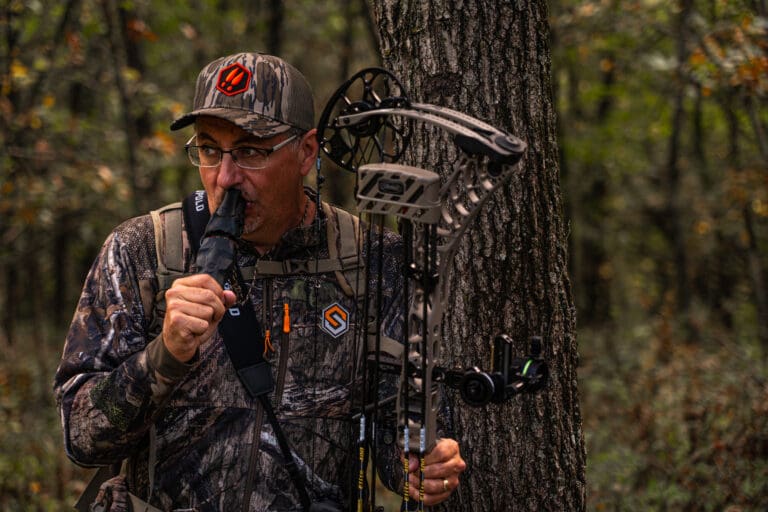
Using a grunt call and rattling bag in October is another one of the most exciting and action-packed times for hunting mature bucks.
By mid-October, mature bucks still haven’t ventured far from their home range or core areas. However, this is also one of the best times to catch bucks on their feet during daylight hours. Just as hunters eagerly anticipate the upcoming rut, mature bucks are also becoming increasingly eager. When hunters employ tools like the Hunters Specialties/DOD Buck Bark Deer Call and the Ruttin’ Buck Rattling Bag, it often piques mature bucks’ curiosity and territorial instincts. This prompts them to respond, showcasing their dominance in the process. The last two weeks of October are often considered the best time to use deer calls and rattling. Especially on cold mornings in late October, a mature buck who is fired up and ready to tangle with another buck in his area is as exciting as any November rut hunt one could experience. To add even more excitement, throw in a deer decoy along with deer scent, rattling, and grunting, and you have one of the most adrenaline-filled hunts a hunter could ask for.
October Cold Fronts
When recently listening to an episode of the Hunt Stand podcast, I was intrigued by a statement stating that October cold fronts can be one of the best times to hunt a mature buck over any other time of the year.
As they mentioned on the podcast, many hunters believe that October bowhunting, or the October lull, is a time when bucks disappear, and hunting isn’t good enough to get out of bed. I’m afraid that’s not right. During early October, daily high temperatures often linger, creating an atmosphere reminiscent of summer than ideal deer hunting conditions. Nevertheless, the missing ingredient to ignite significant buck movement is often a cold front. By closely tracking the weather or utilizing tools like the Hunt Stand app to pinpoint the arrival of the next cold front, hunters can increase their chances of witnessing a mature buck on the move during daylight hours. Being prepared in a tree stand at such times dramatically enhances the likelihood of a successful encounter.
When a cold front suddenly enters an area, deer are much like humans and get the urge to want to get out and do more. The cool air creates an energetic feeling for bucks to move around, check scrapes, chase around a few does, and get a feel of the area to see what is in store for the upcoming rut. During an autumn cold front, the action that can be seen will leave hunters knowing October is anything but a lull.